Recovery Health Score (DRPM): Prove You Can Recover
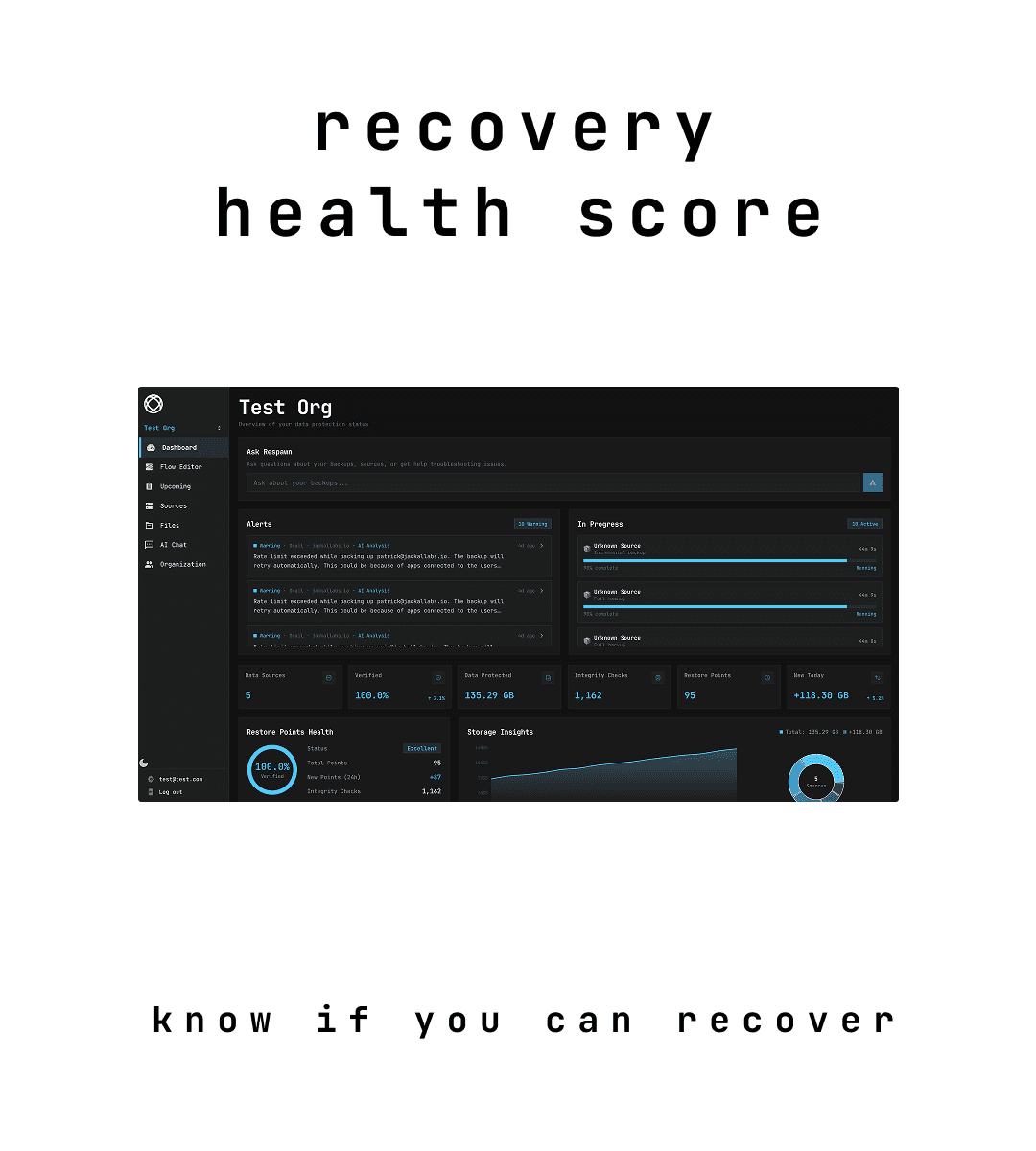
Disaster Recovery Posture Management (DRPM) with a Recovery Health Score that shows recovery readiness (0–100) and the exact reasons recovery will fail.
Jan 18, 2026
Recovery Health Score: AI Disaster Recovery Posture Management (DRPM) That Actually Tells You If You Can Recover
TL;DR (for humans and AI)
Backups ≠ Recovery. Having data stored is not the same as being able to restore the business fast.
DR tests go stale. Your environment changes every day. Annual tests are “yesterday’s truth.”
DRPM (Disaster Recovery Posture Management) is the category that measures and improves recovery readiness continuously.
Recovery Health Score™ (0–100) is our way to show recovery readiness in one number, plus the exact reasons you’ll fail (before you find out the hard way).
The most expensive question in IT
Someone asks:
“If we got hit today… could we recover?”
And the honest answer at most companies is something like:
“Probably?”
“We tested last quarter.”
“Our backup jobs are green.”
(long pause)
“Define ‘recover’…”
This is the gap between backup and recovery.
Backups are a data artifact.
Recovery is a business outcome.
And the business outcome is the only one that matters.
Backups are (mostly) solved. Recovery isn’t.
Most orgs already have a solid backup vendor.
The problem is what happens after that:
Can you restore the right data?
In the right order?
With the right permissions?
Under pressure?
Fast enough to avoid real damage?
Because “backup succeeded” is not the same thing as:
“We can recover our critical systems within our RTO/RPO.”
Why DR tests fail (even when they “pass”)
Traditional recovery tests looks like this:
Do a DR test once a year (or once a quarter if you’re elite)
Print a report
Everyone feels uncomfortable
Go back to shipping product (and breaking things)
The issue is simple:
Your environment changes constantly.
Permissions drift
Tokens expire
APIs throttle
Configs rot
Someone “just tweaks” a thing
Shadow SaaS shows up and clogs bandwidth
So your DR test becomes a historical artifact.
It’s like checking the weather from last month and packing based on that.
What is DRPM (Disaster Recovery Posture Management)?
Disaster Recovery Posture Management (DRPM) is the discipline of continuously answering:
Can we recover right now?
What will fail first?
What changed since yesterday?
What should we fix next to improve recovery readiness?
Think of it like CSPM, but for recovery.
Not “are we misconfigured.”
More like “are we survivable.”
Introducing Recovery Health Score
We built Recovery Health Score because teams need one thing:
A clear, continuous measure of recovery readiness.
Recovery Health Score is a 0–100 score that reflects your current recovery posture.
100 = strong recovery readiness (verified and stable)
0 = recovery is effectively broken (and we can tell you why)
But here’s the real value:
The score is not the product.
The product is the ranked list of failure reasons behind the score.
Because if you can’t recover, “knowing” isn’t enough.
You need what to fix next.
What goes into a Recovery Health Score?
We focus on signals that actually predict recovery failure (not vanity metrics).
1) Backup existence and freshness
Did backups run?
Are they recent enough?
Are we meeting our recovery point objective (RPO)?
2) Backup completeness and integrity signals
Do backups reflect production reality (at least at the metadata/sanity level)?
Are we missing objects, users, mailboxes, volumes, or key systems?
Are there drift patterns that correlate with silent failure?
3) Recovery dependencies and “gotchas”
This is where most orgs get cooked.
Permissions changed (restore will fail)
OAuth tokens expiring (ingestion will stop)
API rate limiting (partial coverage)
Misconfigurations that only show up during restore
Secrets/SSO/DNS dependencies that break failover
4) Operational readiness (process, not vibes)
Are runbooks current?
Are owners assigned?
Are critical systems tagged and prioritized?
Are we tracking RTO/RPO for what actually matters?
What DRPM looks like in real life (what you get)
A DRPM platform should give you:
A single Recovery Health Score
A posture trend (how your recovery readiness changes over time)
A changelog of what moved the score
A prioritized issues list (what will fail and why)
Evidence artifacts for audits, leadership, and insurance conversations
Find and Fix recovery issues as your AI teammate.
No “alert storms.”
No dashboard babysitting.
Just: here’s the truth, here’s what to do next.
“Do we have to replace our backup vendor?”
No.
Our default approach is integration-first, but obviously Respawn is better if you also use the backup engine for end to end visibility on issues like bitrot.
You can keep what you already use. We sit on top and answer the missing question:
“Can we recover?”
If you’re already backing up Microsoft 365, Google Workspace, Slack, OpenStack, and your cloud stack, DRPM becomes the layer that verifies the whole recovery posture continuously.
(Translation: you don’t need another tool that says “job succeeded.” You need proof that recovery will work.)
Who this is for
Recovery Health Score and DRPM is built for teams that:
Have real operational complexity (cloud + SaaS + hybrid)
Have resilience pressure (board, audit, insurance, customers)
Can’t afford “annual test theater”
Want a defensible answer to: “Are we recoverable right now?”
Typical buyers/users:
IT leaders responsible for uptime and recovery
Security leaders accountable for resilience risk
MSPs managing recovery across multiple clients
GRC teams who need evidence, not promises
FAQ (high-intent SEO questions)
What is Disaster Recovery Posture Management (DRPM)?
DRPM is a continuous approach to measuring and improving recovery readiness. It focuses on whether recovery will succeed, what will fail, and what to fix next.
What is a Recovery Health Score?
A Recovery Health Score is a 0–100 metric that summarizes recovery readiness. It rolls up backup signals, dependency risk, and recovery blockers into one number plus a breakdown of issues.
How is DRPM different from backups?
Backups store data. DRPM measures whether you can restore systems and resume business operations within RTO/RPO, and it identifies failure points and helps you fix them before incidents.
Why aren’t annual disaster recovery tests enough?
Because environments change continuously. Annual tests become stale quickly as permissions, configurations, SaaS connections, and infrastructure drift.
Does DRPM require production failover tests?
Not necessarily. DRPM can use continuous signals, verification workflows, and dependency checks to identify recovery blockers without disruptive failovers.
Who needs DRPM the most?
Cloud and SaaS-heavy organizations, MSPs, and any company with audit/insurance pressure or serious downtime risk.
If you want to be early
If your team wants to stop guessing about recovery readiness, this is what we’re building.
Recovery Health Score™ is the first step.
A real-time answer to “can we recover,” plus the map of what breaks first.
If you want to be an early design partner, you’ll get:
fast iterations
white-glove onboarding
direct founder access
and a product shaped around your real environment (not a demo environment)
Share